Showing posts with label science. Show all posts

Thursday, February 6, 2014

Off to the Science Center to eat bugs

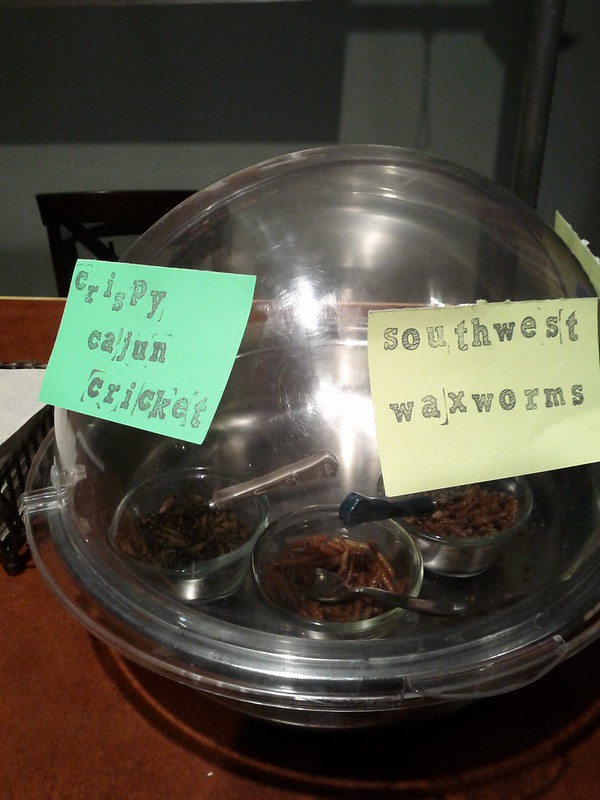
A trip with my kids to the St. Louis Science Center proved something cool: bugs are yummy, except crickets.  They had a special exhibit called Harry's World, which was an exhibit filled with bugs.  It had cockroach races, a house where children pretended to be a Terminix representative and search for bugs, butterflies, and even some edible bugs.  And that was the most important spot.  An entomoligist, every day, prepares bugs for the people to try and taste.  So, I had to give a try.  Even more so, Andrew Zimmern, this is for you.


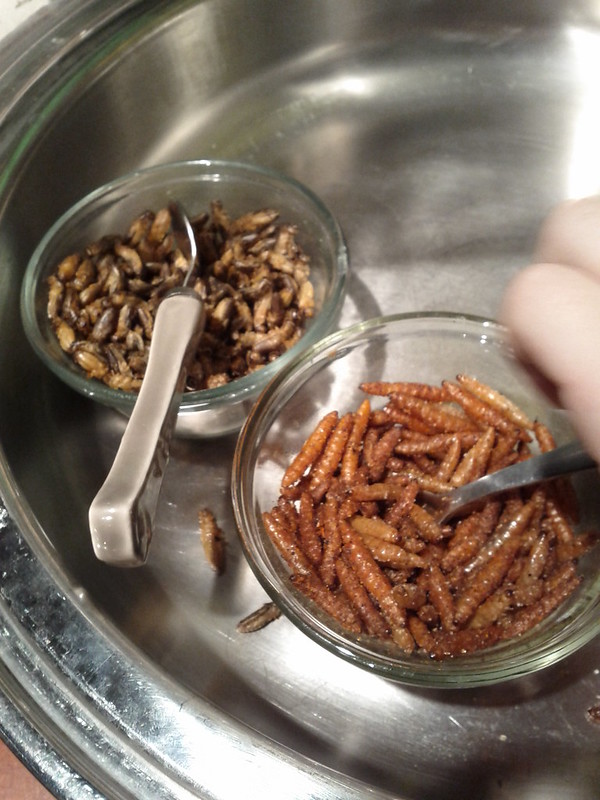
So, there was a bowl of crickets and two bowls of waxworms.  There was one waxworm that had a spicy hot pepper and Southwest flavor to it.  The other waxworm had a sugar and cinnamon seasoning.


So, my review of the bugs is this: the cinnamon and sugar waxworms tasted just like dry Cinnamon Toast Crunch cereal.  I could eat a bowl of them.  As long as they don't get soggy in milk.  The Southwest style waxworms were a bit spicy and the spices worked well also.  As for the crickets, the taste was okay, but a wing got caught in the neck of my throat and reminded me of the same feeling as when you eat popcorn and get a slip of kernel on your throat.  It took me several minutes till I got a drink to wash it down.

Still, the most amazing thing that made this experience even more amazing was doing it with my two boys.  I held out my hand with the Cinnamon and Sugar Waxworms and offered one to both of my kids after trying one.  My oldest, who normally is very grossed out about bugs and slimy things, immediately and without hesitation, reached into my hand, picked one up and ate it.  My other son, who loves things of the macabre, loves bugs and the strange and odd, was afraid to eat the bugs and took a few steps back from me.

I think that experience is likened to that of Andrew Zimmern's first experience with strange food.  I think that kids will do and try anything, provided that a positive role model does the same. 


Tuesday, February 4, 2014

Good Eats LIVE!- sorta

Okay, so maybe it wasn't just like Good Eats, but at least the same funny and interesting Alton Brown was at the Fox on this past ugly and icy Saturday night.  I love the show Good Eats and I have even compared it to my favorite cooking show of all time :The Frugal Gourmet.

My Saturdays were all the same when I was young.  My parents wanted us to go outside and play for the most part of the day.  But at the same time, they allowed us some tv time.  So, what my 3 other brothers and I did, was watch cartoons until the cartoons stopped, around 11:00.  Now, at 11:00 on the local PBS station, there was this show called The Frugal Gourmet hosted by Jeff Smith.  I think the show was actually the first cooking show that Elmo, of Sesame Street, was on.  Now, what you had in the 90's here, was a cooking show where this older man would not only talk about the food he was cooking, but throw in some reasoning as to why things were happening.  He didn't get as much into the science, but at least he gave an explanation of how yeast works and why we make bread that way and so forth.  I remembered it being my favorite show and it certainly was fun to watch Victory Garden right afterwards.

Alton Brown, as the audience got to see him on Saturday night, is exactly like his Good Eats personality.  Like any good teacher, he mixes some real world information into the science and learning part.  His experiments reminded me of items created by Jamie and Adam of Mythbusters.  His up-beat and educational music reminded me of They Might Be Giants as they sing songs about the sun or photosynthesis. His cooking though, reminds me Jeff Smith in his calm and patient manner, with a lot of wit and humor thrown in.

Songs about Caffeine, which is my favorite drug, and pork chops seemed to fit with the giant pizza cooker using 54 lights.  The stories that he used as examples about his life and his family seem to resonate with everyone, or most people or at least me, when it comes to family and children.  And while there was a large portion of the show that was scripted and rehearsed, there was some that was not.  For instance; I have never been to a concert, in any other city, that has ever had a person doing the interpretation into sign language.  When you live in St. Louis and you do St. Louis things, the signer is forgotten or even over-looked because there is one everywhere.  But it appeared that this may have actually been the first time that Alton Brown has ever had one for his show.  As one of his volunteers had put it: "you talk a lot".  As fast and with as much information as Alton Brown gives people, I would feel bad about those who have to sign it. Alton got her to do the sign for 'pole dancer', which I think kept him happy for the night, and even threw him off track once or twice.

I thought the show was great as everything that was explained before the show, did actually happen.  He also suggested that the show was done for him, and not us, and there was some complaining about there being only 2 cooking demonstrations, however since the show was filled with many things, it was a variety show and not just a cooking show.  I liked the show very much and even bought a hat at the end, considering that my other hat, with a red circle and silver fork on the top, is the only chef's hat I had.

I also have to give full marks for bravery, just like the kind that Wesley got after making it through the fire swamp, to Alton Brown.  For not only did he ride on his tour bus through the cold and ice and snow, but he also performed in it.  Albeit, he was inside the Fabulous Fox theater.  But as his show warmed the minds and hearts of the people, outside it only grew more and more like planet Hoth.

So, to Alton Brown, thanks for putting on a great show in St. Louis.


Friday, October 22, 2010

Is cooking an art or a science?

I love to cook, I really do, but cooking every day can get a bit boring and tedious when you are a father of two young boys and half of your cooking time involves keeping tiny hands away from the stove/oven and the counter top where you are cutting and working. However, as one who failed chemistry, the first time, will tell you, science is hard at first and then easy on the second run.

What am I dribbling about?

Molecular Gastronomy is the fancy way of saying 'art of cooking' without the art part but meaning more of the science of cooking.  With cooking you learn how to boil and egg and how to make ice.  But, with the science part, the molecular gastronomy part, you learn why the egg cooks and how the ice is formed from the water.

In a container pour 250 grams of H2O and submit to sub-freezing temperatures of 32 degrees F or below.

Why does ice form?  As the water becomes colder, the liquid condenses to the point where it becomes a solid.  Knowing this, and knowing that each crystal that forms in ice is important to its structure can give someone the information to play with it; perhaps by making ice cream or sorbets.  Once you have the science down, you can do whatever you want within the rules of the formula and therefore use art and creativity.  So, perhaps the art could follow the science.

On the other hand, inventors over time pretty much decided to do things through trial and error and not cared about the science, in a way.  If I mix chocolate sauce and milk together and create chocolate sauce, I am not trying to come up with a new balance of chocolate particles swimming in the immersion.  I will not measure the chocolate down to the gram and the milk as well as try many different experiments to see which one of which amounts I like the most.  I will simply squeeze the bottle a bit longer for more chocolate.  Its not science, its creativity and fun. 


Now, my wife decided to cook a chicken this week.  It is simple science: you clean the chicken, cook it on all sides in a hot pan to get the skin done a bit.  Then you place it in a Dutch Oven for about 20 minutes per pound at 350 degrees F and then an additional 15 minutes after that.  Our 7 pound bird was stuffed with some fresh herbs, from our garden, along with a mix of vegetables that were cut and placed inside here with some water. A bit over two hours later, this is what came out.  There is a science behind it and we know that if we place it in the oven for this long that it will come out cooked, filling the whole house with that indistinguishable smell of roasted chicken, and any liquid in the pot as well will be the best tasting broth we have ever had.  My wife knew this, she knew this would happen, so after she had the science down, she went on with the recipe, her way, by adding her own mix of herbs and vegetables.

Is my wife and expert scientist?  No, but she can cook well and that shows you that art can come after the science.  I am thinking of only our examples in this case, but am almost certain that art follows the science when cooking, just like the form follows the function.

Does anyone else think the same or different?

Saturday, April 3, 2010

An imperfect sphere...

Ever since I saw an episode of Top Chef, in which the chef made some food into spheres, I was hooked, thinking it was the best way and a brand new method. After all this time I thought that food was cooked the way it was given, as in, the only way to change the texture of food was to do it by juicing it or mashing it. A carrot has the carrot texture unless you juice it or mash it then it has a liquid texture and mashed potato texture.

So, as great chefs like the ones at WD50 and El Bulli have shown us, using chemicals we can drastically change the texture of things. After reading a free downloadable book on textures and hyrocolloids, by Martin Lercsh, I was very interested in other hydrocolloids. Recipe upon recipe of spherification gave ideas for me to try. One of the recipes used olives and making olive juice and then dripping it into ice cold oil, making the spheres form there. A good idea and worked for the mixologist in the video, but not for me.

I did the next best thing, finding a place that sold a mixture of an unknown percentage of sugar and sodium alginate, I thought it was pure sodium alginate but was mistaken, I used it anyway, using twice as much as the recipe called for. I also bought some calcium chloride for use as well. The recipe had me taking a soda, boiling it a bit, then adding the sodium alginate, or in my case, adding a bunch of the mixture.

I let it cool so it would start to gel. I then mixed water and the calcium chloride and dripped the soda mixture into the water one.
Little spheres formed perfectly and floated to the bottom of the bowl.
I then poured the whole bowl over a sieve and collected the water in another bowl, underneath, to be used again. I rinsed the caviar off in water, then dipped in a separate bowl of clean water. When I had enough, I placed them in a white dish and thought they looked like caviar, my wife, the sushi lover, thought it looked like flying fish roe.
However, the taste wasn't what I had expected: The small balls of strawberry soda flavor, had a gummy shell but a juice on the inside, like a paintball. I rinsed them off multiple times but still, there was a salty or sour flavor afterwards, which could have come from the calcium chloride since it is a salt. I have read online that people say that it has no taste, but it clearly does. It was an interesting process and I am very happy to have done it, but this may not be something I would do many many times.

Friday, March 12, 2010

A breakthrough in low calorie foods

After 9 trials and 20 pounds of sliced peaches, over one pound of sweetening agent, and over a cup of lemon juice, the first batch of real peach jam has been created by my new company. These trials were new and experimented formulas in making a sugar-free fruit jam that tasted good and still had low calories and low GL's for diabetics. Is this simple? No. A normal recipe that you may find for jam for making 6-8 jars can have as much as 5-6 cups of sugar in it. That comes to almost a cup of sugar in each jar of jam. That is a lot of calories extra; about 774 calories worth of pure sucrose. That is a lot of calories.

I finished my jam with the following information:
Serving size: 1 tablespoon
Calories: 7
Total carbohydrates: 3g
Sugars: 1

That's it!

The best part is, in an 8oz jar, there is 205 grams of finished product and that means that a whole jar has 78.4 calories!

I dare you to find a jar of jam that has less for the whole jar!

I thought my calculations were incorrect and compared it to a sugar free jam called Palamers raspberry spread. A tablespoon of their raspberry spread contained a whopping 40 calories! I thought how my numbers could be so far off and it came to me: I have 4 ingredients. Palamers has 6. Besides raspberries which are low in calories, it also had pear and grape juice. A cup of grape juice has 160 calories and a cup of pear juice has a bit much of the same. So that much extra calories are in a batch of jam from this company. Guess how many calories are in a single cup of sliced peaches? 11 calories. That is it, 11 calories!

This jam will start to make its way around and soon the trials on applebutter will begin. That's right, what about making low calorie and no sugar apple butter.

Monday, January 25, 2010

The science behind a cookie.

Cooking is both an art and a skill. It uses creativity, risk, science and math in order to pull out a good dish out of just about anything. Just ask Morimoto about the strange ingredients he is given and the wondrous concoctions that he creates. The biggest thing that draws me into cooking is the science and math, which is thrown together under the gastronomy term: the science of cooking. While there is a simple recipe to making chocolate chip cookies, the hard part is not making them with white chocolate chips instead of milk-chocolate, but instead taking out many or replacing many of the ingredients becomes more of a trail-and-error with science and math.

For example: I am working on a low GL chocolate chip cookie. Whoa, wait, what? What's a GL? Okay, let's start from scratch. A GL is an abbreviation for a Glycemic Load, which is the amount of sugars that enter your bloodstream and how long it stays in your body before being countered by the insulin your body releases. So, if you eat something that has a high GL, say of 50, then that means that even after your body releases insulin to deal with the sugars in it, it will take a longer time for those sugars to dissipate than an item that has a lower amount of GL's. Now GL's measure the sugars in an item and if there is too much sugar in an item, more than your body can handle, the excess sugar in your blood stream can mess with your body, causing headaches, fatigue, mood swings or get stored as fat. So watching your glycemic load levels day-to-day can help you feel healthy, stay healthy, and help you lose wait.

Now, my recipe for chocolate chip cookies calls for 3/4th of a cup of packed brown sugar. A cup of brown sugar has about 1 tablespoon of molasses and 1 cup of white sugar. Well, that means that a 3rd of a cup of brown sugar has about 1 & 1/2 teaspoons of molasses. Molasses is relatively low on the GL scale and when mixed with something that can act as a sweetener in its place, like 3/4ths of a cup of Stevia, you get something that tastes like brown sugar, but has almost no GL's and almost no calories.

But while the math is there, I had to play around with the science. Sugar plays an important roll in cooking and baking. In cookies, it helps create the texture. The first step is to mix butter with the sugars, to creme them together. The idea is that the sugar mixes with the butter while it pulls air into the mixture. The sugar helps to tear pockets in the fat and air fills the gaps. This creates a creamy texture for the base of the cookies. When they tell you that the butter needs to be room temperature, this is important as the temperature and the softness of the butter determines how easy it is to create the fluffiness of the cookies. If the butter is too cold, you will have super fluffy cookies that would come up as large and crunchy and if your butter is warm then your cookies will become flat and soft and chewy.

That texture, shows through to when the cookies are cooked as well. As if the cookies have air pockets made from the sugar and butter, then the air heats up and cooks its little cell, creating a crunchy cookie. If there are not as many air pockets, then the air only heats up it's immediate area, which normally is just the whole cookie, allowing for cookies that are still soft and chewy.

In the case of my stevia/molasses use, it functions the same way, as far as tearing through the butter to create the air pockets for the cookie. However without the addition of unnecessary calories, it works better for everyone will delivering the same thing. The glycemic load of the molasses and stevia would be 4.5 GL's. Whereas the glycemic load of 3/4ths of a cup of brown sugar would normally have roughly 113 GL's.

What this is leading up to, is a low GL sugar-free chocolate chip cookie. One that doesn't taste like the sugar-free cookies in the store, but one that tastes like a normal fat filled, sugary and rich cookie. No one one a sugar-free diet will touch a sugar-free cookie, unless it tastes good. As my mantra of a chef, "if it doesn't taste good, don't eat it", there is no reason that diabetics and dieters should be forced to eat anything different than the rest of us.